What is it about stepping into the Renaissance galleries of an art museum that causes paintings to snap into focus? It’s not only the egg tempera paint. It’s also because these Old Master artists portrayed big ideas through recognizable imagery rather than gestural brushstrokes.
The difference may seem slight, but it’s critical. A modern artist like Kandinsky guides you through the meaning of his pictures. A Renaissance artist like Titian points to his work and then confidently walks away.
Fra Angelico offers this same quiet clarity. He opts for familiar figures and objects rather than abstract strokes of paint that require interpretation.

A master storyteller
Angelico was born Guido di Pietro in Florence, Italy, around 1395. He joined the Dominican Order of friars at a young age and likely apprenticed with an illuminator—a person who illustrates handwritten books.
Importantly, Dominican friars could venture beyond the walls of their cloister. Angelico was free to explore the narrow and noisy streets of Florence, honing his skills as a visual storyteller.
In Saint James the Greater Freeing the Magician Hermogenes, the devil is literally in the details. This scene is taken from The Golden Legend, a 13th-century text famous for its imaginative stories of Christian saints.
Angelico captures the pivotal moment when Saint James, one of Christ’s original twelve apostles, asks a new Christian convert to untie the evil magician Hermogenes.

In a twist of fate, the sorcerer is bound by the very devils he summoned to kill James. The rope symbolizes his entanglement in the dark arts. Behind him, six double-crossing demons breathe fire and taunt him with their little pitchforks.
By releasing the remorseful magician, James is essentially saying, “Let’s return good for evil, as Christ taught us to do.”
Angelico’s precise brushwork elevates this tale of sorcery into an Early Renaissance masterpiece. Additionally, his use of gold leaf adds visual weight to the luxurious fabrics and the magician’s vainglorious hat.
Making the invisible, visible
To create the Deposition of Christ altarpiece, Angelico transformed the traditional multi-paneled format into a seamless Tuscan landscape populated by figures that express deeply relatable emotions.
Fra Angelico pioneered emotional interiority in art. He laid the stylistic groundwork for Michelangelo, Leonardo da Vinci, and even modern artists like Mark Rothko.
Arts writer Cody Delistraty, “The Paris Review,” 2019

In the center of the painting, Christ’s body slides into the arms of his followers, who synchronize their somber task with a glance here and a gesture there. His mother kneels in prayer, her eyes fixed on her dead son. Mary Magdalene kisses his bloodied feet.
Meanwhile, a man holds up a crown of thorns and three long nails as if to say, “Won’t these make great holy relics?” The man bears a striking resemblance to Palla Strozzi, the financier who commissioned the work.
Angelico’s attention to the diverse emotions of these figures can be traced back to Giotto, the 14th-century visionary who was instrumental in the development of European naturalism.
A mysterious drawing surfaces
Long ago, an artist layered brown ink on art paper to depict the lifeless body of Christ. While some crucifixions feel overdone, this one does not. Art historians widely credit the unsigned drawing The Dead Christ to Angelico, who may have been working from his Deposition altarpiece.

Did the Strozzi family who commissioned that altarpiece also receive this drawing? No one knows. However, we do know the family’s luck was about to change:
The Strozzi family fortunes turned in 1434 after the return to Florence from political exile of Cosimo de’ Medici. Palla Stozzi was exiled the next month, followed four years later by his son Lorenzo. The Deposition altarpiece would be their final commission.
Carl Brandon Strehlke, “Fra Angelico and the Rise of the Florentine Renaissance,” 2019
Being a sentimentalist, I believe Palla Strozzi took this drawing with him as he fled Florence, never to return.
Small pictures with cinematic pacing
Many Renaissance altarpieces stand on a predella, a low wooden base with small panels that portray the lives of saints. Because people viewed these pictures up close, artists favored lively details over formal symbolism.
An example is Angelico’s Perugia Altarpiece, which depicts Saint Nicholas of Bari, the 4th-century bishop whose generosity inspired the figure of Santa Claus.


It was a dark and stormy night…
Acting as a time-lapse, the first panel seamlessly blends three moments from the saint’s youth into a single landscape. On the left, a newborn precociously stands up all by himself after his first bath. In the center of the wood panel, Nicholas listens to a preacher. The figure disappearing into a church is also the young saint, who has found his true calling.
On the far right, shrouded in darkness, Nicholas discreetly tosses a pouch of gold through a window to provide dowries for three sisters. Their worried father, seen through the doorway, has yet to learn that his daughters have been saved from poverty or worse.
In the second panel, Nicholas—now the Bishop of Myra—urges merchants to donate grain to save his city from famine. The scene then shifts to a blustery sea where sailors pray to Nicholas to save their sinking ship (he does). A dramatic shift in light masterfully separates these two storylines.
The final panel shows Nicholas grabbing an executioner’s blade just in time to save three innocent men from beheading. On the right, the story ends as friends mourn the saint while angels escort his soul to heaven.
A dramatic restoration
Angelico’s altarpieces are so luminous, they can knock the wind out of you. I experienced this firsthand when I saw The Annunciation in Madrid. I didn’t drop dead on the spot, but it was touch and go there for a minute.

Painted for the Santo Domenico monastery, The Annunciation now resides in the Prado, where it recently underwent a stunning restoration. Free of the residue accumulated over 600 years, the surface glistens.
As we removed the gray curtain of pollution, a powerful source of light took possession of the picture. The light recovered its leading role in the composition, a role that transforms it into a mystical light.
Painting restorer Almudena Sánchez, Museo del Prado, 2019
Light illuminates a story of unique breadth. For the first time in art history, an artist places Adam and Eve in an Annunciation scene. As the couple is driven out of Paradise, Eve casts a furtive look at Mary—who is quietly accepting the cosmic responsibility of setting things right.
Angelico captured the gravity of Mary’s response to the revelation that she is to give birth to God in human form:
Mary bends forward, holding her hands to her middle, as if protecting the life that is already within. The angel genuflects, acknowledging the difference in their stations.
The drama is enacted in a loggia. The rational order of the architecture contrasts with the disruption of the historical order. A new era has begun.
Art critic Arthur C. Danto, “The Nation,” 2006
Behind closed doors, a new kind of art
In 1848 art critic John Ruskin traveled from London to Florence to view paintings rarely seen by outsiders. Their emotional impact was so profound that he later wrote, “they seem to transcend art.”

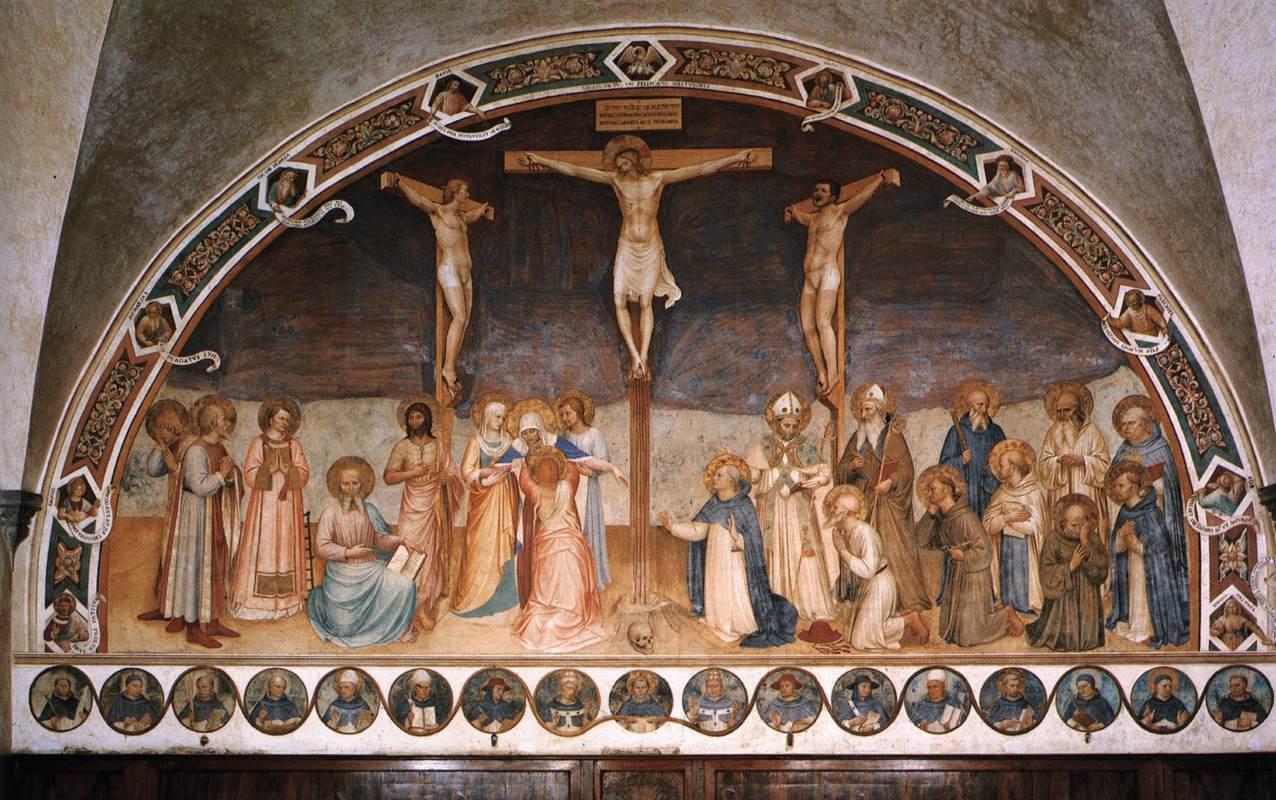
Ruskin encountered these works inside the San Marco monastery, where Angelico had painted nearly 50 frescoes on the walls—including individual paintings for each of the 44 friar cells on the cloistered upper floor. In these private spaces, away from the demands of wealthy patrons, the artist abandoned ornate detail for less complex images designed to inspire humility and meditation.
In cell #7, the staggeringly modern fresco Mocking of Christ depicts Jesus sitting on a wooden block rather than a throne. He holds a reed and a rock instead of a scepter and an orb. Floating, disembodied hands slap him upside the head, while a lout tips his cap and spits in his face.
It’s a provocative image. What emotions might a friar experience while reflecting on Jesus of Nazareth being mocked for speaking out on behalf of our humanity?
The dawn of the Renaissance
Together with Masaccio—the first painter to adopt linear perspective in his work—Fra Angelico led a revolution in Italian painting that profoundly shifted the focus from religious dogma to human potential.
Yet, the modern world scarcely knows his name.
I don’t think Angelico would mind. Ultimately, he painted for an audience of one. The inscription on his epitaph in a Roman basilica reads:
WHEN SINGING MY PRAISE,
DO NOT LIKEN MY TALENT TO APELLES.
SAY, RATHER, THAT, IN THE NAME OF CHRIST,
I GAVE ALL I HAD.

Postscript: If you happen to be in Florence…
See “Rothko in Florence” — a special exhibition at the Palazzo Strozzi (yep, that Strozzi family) now thru August 23, 2026. The show includes a satellite exhibit at the Museo di San Marco, where Mark Rothko’s paintings are presented in conversation with Fra Angelico’s frescoes.